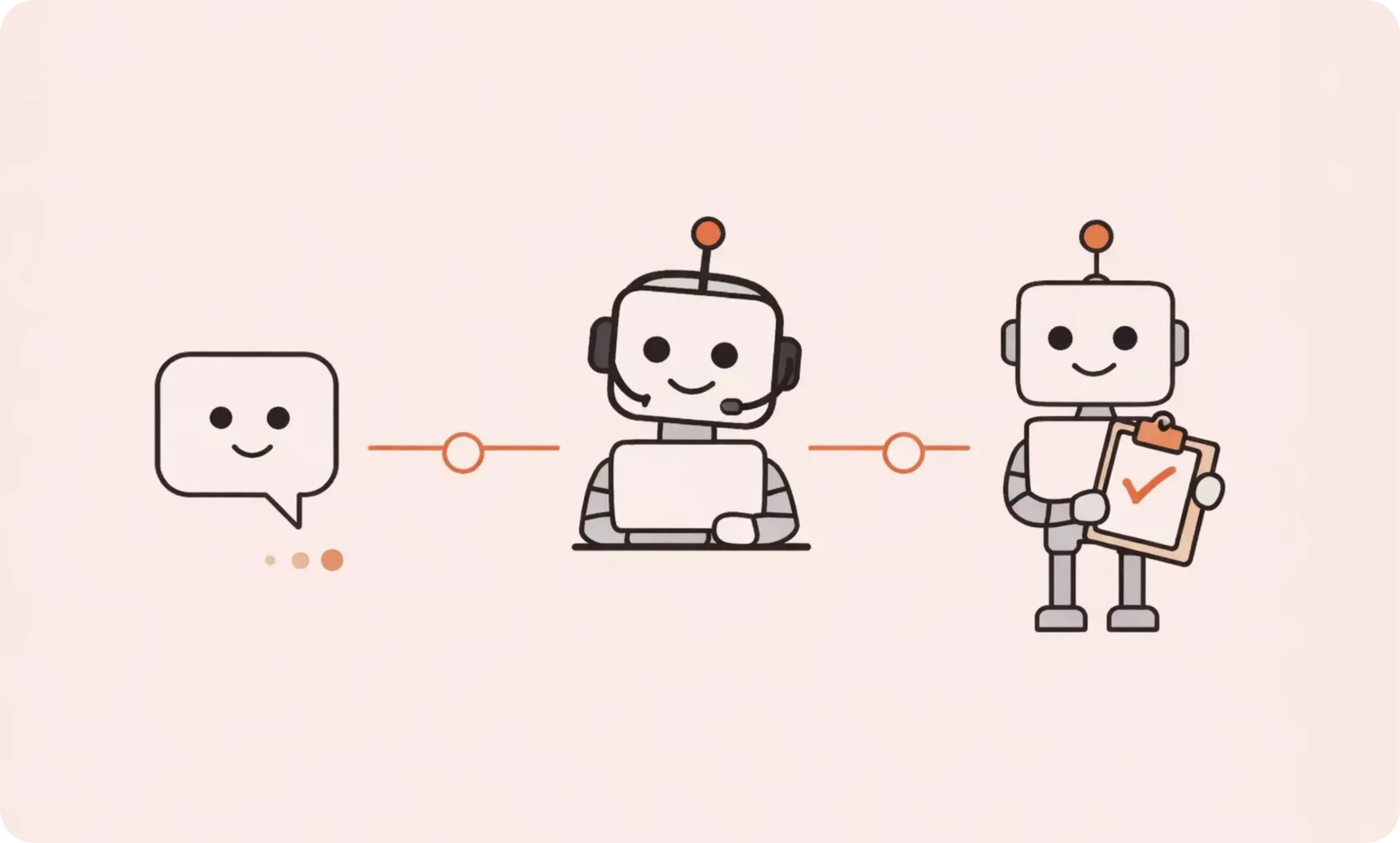
AI Agents in Customer Service: From Chatbots to Autonomous Solutions
AI Agents in Customer Service: From Chatbots to Autonomous Solutions
Customer service has always been a balancing act: provide great support without spending more than you can afford. For years, businesses tried to solve this with chatbots — and for years, those chatbots frustrated more customers than they helped.
That era is over. AI agents represent a fundamentally different approach to customer service automation, and the results are hard to ignore.
The Evolution of Customer Service Technology
To understand where we are, it helps to see how we got here:
Phase 1: Script-based chatbots (2015–2020)
These were decision trees dressed up as conversations. Users clicked buttons or typed exact keywords. If the query did not match a predefined path, the bot was useless. Customer satisfaction was low, and adoption stalled.
Phase 2: NLP-powered chatbots (2020–2024)
Natural language processing allowed bots to understand intent rather than exact phrases. This was a meaningful improvement — bots could handle a wider range of queries and provide relevant answers. But they were still reactive, handling one question at a time without deeper reasoning.
Phase 3: AI agents (2024–present)
AI agents do not just answer questions. They understand context, reason through problems, take actions across multiple systems, and handle complex multi-step interactions autonomously. This is not an incremental improvement — it is a different category of technology.
What Makes AI Agents Different
An AI agent in customer service is not a fancier chatbot. Here is what sets them apart:
Contextual Understanding
AI agents understand the full context of an interaction. They can read a customer's message, check their account history, review previous conversations, and understand the nuance of what is being asked — all before responding.
Multi-Step Problem Solving
While a chatbot answers a question, an AI agent solves a problem. If a customer reports a delivery issue, the agent can:
- Look up the order in the order management system
- Check the shipping status with the logistics provider
- Determine whether a replacement or refund is appropriate based on your policies
- Initiate the resolution
- Inform the customer with a clear explanation
All of this happens in seconds, without human involvement.
Learning and Adaptation
AI agents improve over time. They learn from successful resolutions, identify patterns in customer issues, and adjust their approach. An agent that handles hundreds of similar inquiries develops increasingly effective resolution strategies.
Seamless Escalation
Good AI agents know their limits. When a situation requires human judgment — a sensitive complaint, an unusual edge case, a high-value customer with complex needs — the agent escalates smoothly, providing the human agent with full context so the customer never has to repeat themselves.
Real Results From Real Deployments
Organizations deploying AI agents in customer service are seeing measurable improvements:
- 40–60% faster resolution times — AI agents process information and take action in seconds, not minutes
- 30–50% reduction in operational costs — handling a larger volume of inquiries without proportional staffing increases
- 24/7 availability — consistent service quality at any time, any day
- Higher customer satisfaction — faster resolutions and no waiting in queues
- Improved agent experience — human agents handle interesting, complex cases instead of repetitive queries
These are not theoretical projections. Companies across industries — retail, financial services, telecommunications, SaaS — are reporting these results in production environments.
Addressing Common Concerns
Despite the clear benefits, organizations hesitate. Here are the most common concerns and the reality behind them:
"Customers hate talking to bots"
Customers hate bad bots. When an AI agent resolves their issue quickly and accurately, most customers prefer it to waiting on hold. Research consistently shows that customers care about outcomes — getting their problem solved — more than the method.
"AI will make mistakes and damage our brand"
Any customer service channel involves errors — human agents make mistakes too. The difference is that AI agents can be monitored systematically, improved continuously, and configured to escalate when uncertain. Well-implemented AI agents often achieve higher consistency than human teams.
"We will lose the personal touch"
AI agents free your human team to provide the personal touch where it matters most. Instead of spending time on password resets and order status inquiries, your best people can focus on complex situations that genuinely require empathy and creative problem-solving.
"Our processes are too complex for AI"
Complexity is actually where AI agents shine. Simple, structured queries can be handled by basic automation. It is the complex, multi-step processes — the ones that require checking multiple systems and applying judgment — where AI agents deliver the most value.
"Implementation will be disruptive"
The best approach is gradual. Start with a specific category of inquiries, prove the value, then expand. Most organizations begin with high-volume, well-defined query types and progressively give the agent more responsibility.
How to Get Started
Implementing AI agents in customer service does not have to be a massive, risky project. Here is a practical path:
Step 1: Analyze Your Current Inquiries
Categorize your customer interactions by type, volume, and complexity. Identify the categories that are:
- High volume (lots of similar inquiries)
- Well-documented (clear resolution procedures exist)
- Data-accessible (the information needed is available in your systems)
These are your best candidates for the first AI agent deployment.
Step 2: Prepare Your Knowledge Base
An AI agent is only as good as the information it can access. Ensure your:
- Product documentation is current and comprehensive
- FAQs cover common scenarios
- Policies and procedures are clearly documented
- Systems (CRM, order management, etc.) have accessible APIs
Step 3: Start With a Focused Pilot
Deploy the AI agent for one specific category of inquiries. Set clear success metrics (resolution rate, customer satisfaction, handling time) and monitor closely. A focused pilot lets you learn and adjust before scaling.
Step 4: Iterate and Expand
Based on pilot results, refine the agent's capabilities and gradually expand to additional inquiry types. Each expansion benefits from the lessons of previous phases.
Step 5: Optimize Continuously
Monitor performance, gather feedback, and improve. AI agents get better over time — but only if you actively manage and refine them.
The Human-AI Partnership
The goal is not to replace your customer service team. The goal is to create a partnership where AI handles the volume and your people handle the value.
In this model:
- AI agents handle routine inquiries, provide instant responses, operate around the clock, and maintain perfect consistency
- Human agents handle sensitive situations, build relationships with key accounts, solve novel problems, and provide the empathy that complex situations require
This partnership delivers better outcomes for customers, better working conditions for your team, and better economics for your business.
What Comes Next
AI agents in customer service are not a future possibility — they are a present reality. The technology is mature, the ROI is proven, and the competitive pressure is building. Organizations that delay risk falling behind competitors who are already delivering faster, better, more cost-effective customer service.
The question is not whether to adopt AI agents, but how quickly and effectively you can do so.
Ready to explore AI agents for your customer service? Contact WiseMonks to discuss a practical implementation plan tailored to your business.