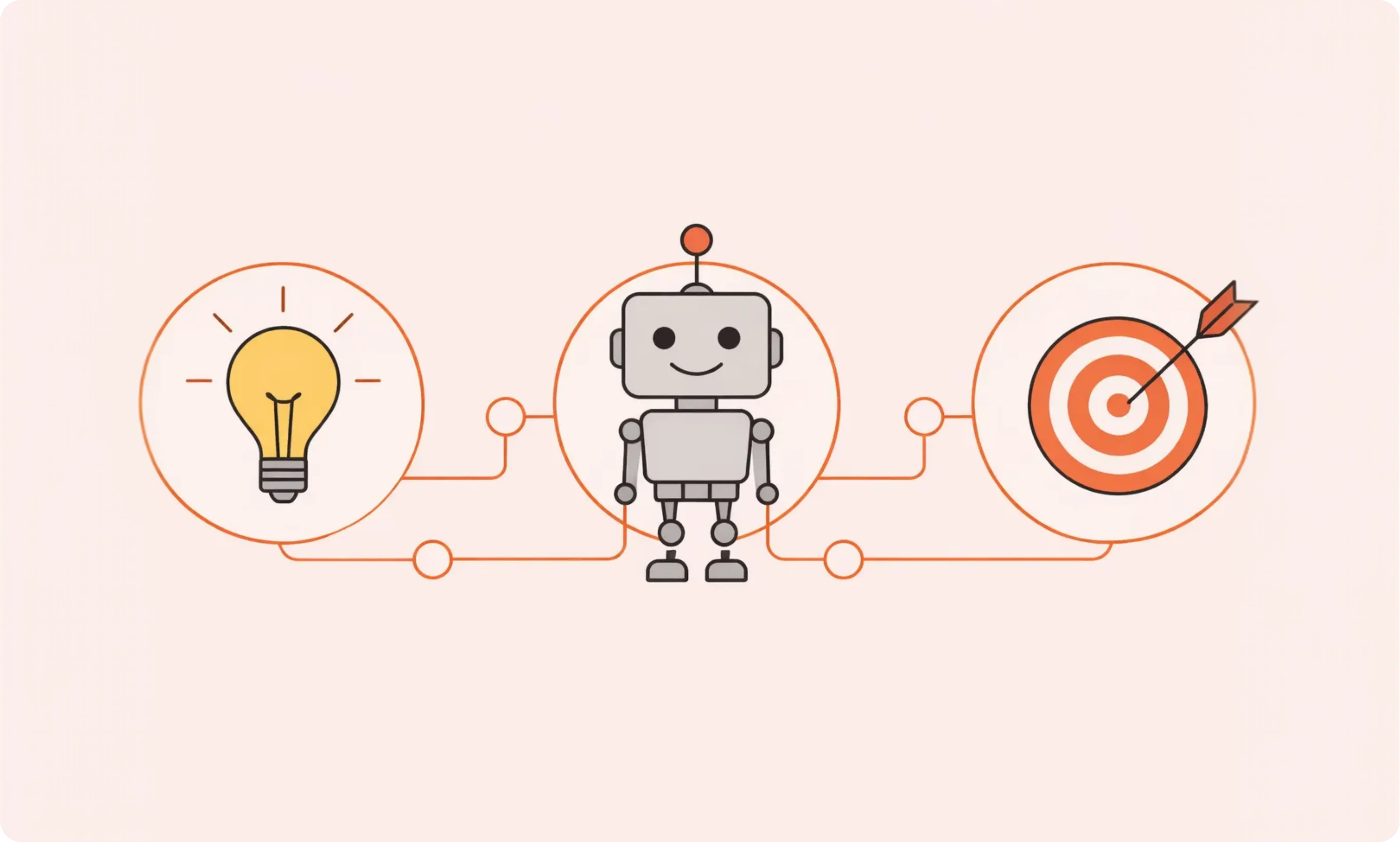
AI Implementation Stages: From Idea to Results
AI Implementation Stages: From Idea to Results
Artificial intelligence holds enormous potential for business — but potential alone does not produce results. According to industry research, 70–80% of AI projects fail to deliver expected outcomes. The main reason is not the technology itself, but how it is implemented.
Companies that succeed with AI share a common trait: they follow a structured, stage-by-stage approach rather than jumping straight to building models. In this guide, we break down the six stages of a successful AI implementation and the mistakes to avoid along the way.
Why a Structured Approach Matters
AI is not a plug-and-play product. It requires understanding your business context, preparing your data, and iterating on solutions. Organizations that skip steps — rushing from "we need AI" to purchasing tools — almost always end up with expensive shelf-ware.
A structured implementation process helps you:
- Reduce risk by validating assumptions early
- Control costs by identifying the highest-impact use cases first
- Build internal capability so AI becomes a lasting competitive advantage, not a one-off experiment
The 6 Stages of AI Implementation
Stage 1: Needs Analysis and Opportunity Assessment
Before any technology decisions, you need to understand where AI can make the biggest difference in your business. This stage involves:
- Mapping current processes — identifying bottlenecks, repetitive tasks, and decision points where data is underutilized
- Defining business goals — what does success look like? Faster customer response? Lower operational costs? Higher conversion rates?
- Assessing feasibility — not every problem needs AI. Some are better solved with simpler automation or process redesign
The output of this stage is a prioritized list of AI opportunities ranked by potential impact and implementation complexity.
Common mistake: Starting with the technology ("We need a chatbot") instead of the problem ("Our support team spends 60% of their time answering the same 20 questions").
Stage 2: Strategy and Roadmap
With clear priorities in hand, you develop a concrete plan. This includes:
- Selecting the first use case — start with a project that is high-impact but manageable in scope
- Defining success metrics — KPIs that tie directly to business outcomes (cost savings, time reduction, revenue increase)
- Resource planning — what data, tools, and skills are needed? What can be done internally versus with external partners?
- Timeline and milestones — realistic expectations for each phase
A good AI strategy is not a 50-page document. It is a clear, actionable plan that the team understands and believes in.
Common mistake: Trying to solve everything at once. The best AI strategies start narrow and expand based on proven results.
Stage 3: Data Preparation
Data is the foundation of any AI system, and this stage is where many projects stall. Activities include:
- Data audit — what data do you have? Where does it live? How clean and complete is it?
- Data collection and integration — bringing together data from different systems (CRM, ERP, support tickets, documents)
- Cleaning and structuring — removing duplicates, filling gaps, standardizing formats
- Privacy and compliance — ensuring data handling meets regulations like GDPR and the EU AI Act
This stage typically takes longer than expected. Budget for it accordingly.
Common mistake: Underestimating data preparation. Industry estimates suggest that data work consumes 60–80% of the total effort in AI projects.
Stage 4: Prototype Development
Now you build the first working version. The goal is not perfection — it is learning. This stage involves:
- Selecting the right approach — off-the-shelf AI services, fine-tuned models, or custom solutions depending on the use case
- Building a minimum viable solution — the simplest version that demonstrates value
- Internal testing — running the prototype against real scenarios with a small group of users
- Iteration — refining based on feedback and performance data
A prototype should answer one critical question: does this approach solve the problem well enough to justify further investment?
Common mistake: Over-engineering the prototype. A proof of concept that takes six months to build defeats the purpose of rapid validation.
Stage 5: Deployment and Integration
Once the prototype proves its value, you prepare it for production use:
- System integration — connecting the AI solution with existing tools and workflows (CRM, helpdesk, internal systems)
- Scaling infrastructure — ensuring the solution can handle production volumes reliably
- User training — helping employees understand how to work with the AI system effectively
- Change management — addressing concerns, setting expectations, and building trust in the new process
Deployment is as much a people challenge as a technical one. Even the best AI system fails if users do not trust or understand it.
Common mistake: Neglecting change management. Technical deployment without user adoption is a recipe for failure.
Stage 6: Monitoring, Optimization, and Scaling
AI is not a "set and forget" technology. After deployment, ongoing work includes:
- Performance monitoring — tracking accuracy, speed, user satisfaction, and business KPIs
- Continuous improvement — retraining models as new data becomes available, refining prompts, adjusting thresholds
- Handling edge cases — addressing scenarios the system does not handle well
- Scaling to new use cases — applying lessons learned to expand AI across the organization
The best AI implementations get better over time. Build feedback loops from day one.
Common mistake: Declaring victory at launch. Without ongoing monitoring, AI system performance degrades as business conditions change.
What a Realistic Timeline Looks Like
Every project is different, but here is a rough guide:
| Stage | Typical Duration |
|---|---|
| Needs Analysis | 1–2 weeks |
| Strategy & Roadmap | 1–2 weeks |
| Data Preparation | 2–6 weeks |
| Prototype | 3–6 weeks |
| Deployment | 2–4 weeks |
| Monitoring | Ongoing |
For a focused first project, expect 2–4 months from kickoff to production. More complex initiatives may take longer.
The Biggest Reasons AI Projects Fail
Looking across failed AI initiatives, the same patterns emerge:
- No clear business problem — AI was adopted for its own sake
- Poor data quality — models were trained on incomplete or biased data
- No executive sponsorship — the project lacked organizational support to overcome obstacles
- Unrealistic expectations — leadership expected instant transformation
- No iteration — the first version was treated as the final version
Every one of these failures is preventable with proper planning and execution.
How WiseMonks Helps
At WiseMonks, we guide organizations through every stage of AI implementation. We bring practical experience from real projects — not theoretical frameworks. Our approach is:
- Business-first — we start with your goals, not with technology
- Hands-on — we work alongside your team, not just deliver reports
- Pragmatic — we recommend the simplest solution that solves the problem
Whether you are exploring your first AI use case or scaling existing initiatives, we can help you move from idea to measurable results.
Ready to start your AI journey? Get in touch with us to discuss your goals and find the right first step.