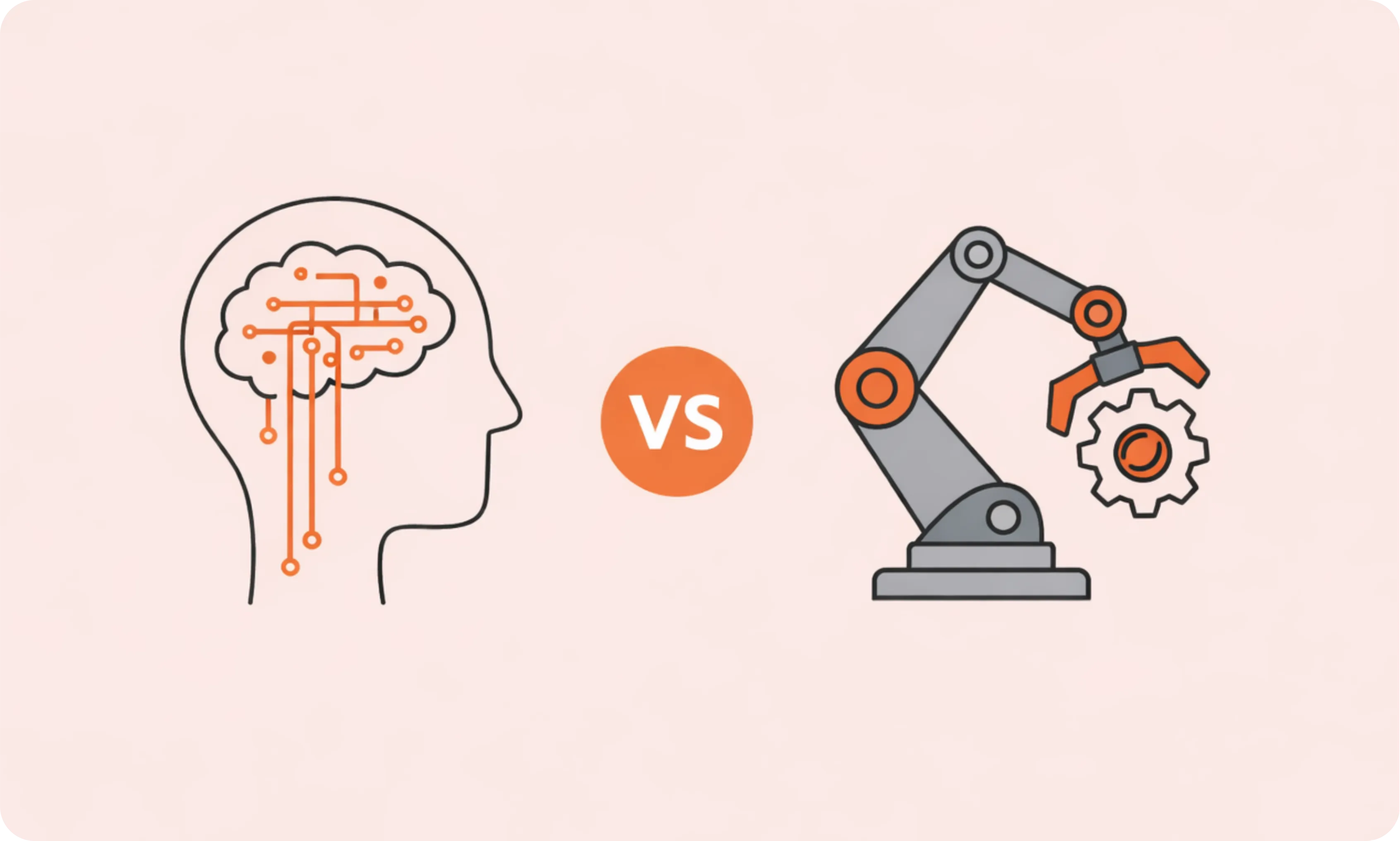
AI vs Traditional Automation: What Should You Choose?
AI vs Traditional Automation: What Should You Choose?
Automation is not new. Businesses have been automating processes for decades using rule-based systems, scripts, and robotic process automation (RPA). What is new is the addition of artificial intelligence — and with it, the ability to handle tasks that traditional automation never could.
But AI is not always the right answer. Sometimes traditional automation is faster, cheaper, and more reliable. The key is knowing which approach fits which problem.
What Is Traditional Automation?
Traditional automation — including RPA — follows predefined rules to execute tasks. Think of it as a very fast, very reliable employee who follows instructions to the letter.
Typical capabilities:
- Moving data between systems (e.g., copying information from an email into a CRM)
- Filling out forms and generating reports
- Processing structured data (spreadsheets, databases)
- Triggering actions based on simple conditions (if X happens, do Y)
Strengths: Fast setup for structured tasks, predictable behavior, low cost for simple workflows, easy to audit and debug.
Limitations: Cannot handle unstructured data (free-form text, images, varied document formats), breaks when inputs change, requires explicit rules for every scenario.
What Is AI-Powered Automation?
AI automation uses machine learning, natural language processing, and other AI techniques to handle tasks that require understanding, judgment, or adaptation.
Typical capabilities:
- Understanding and responding to natural language (emails, chat messages, documents)
- Extracting information from unstructured sources (invoices in different formats, contracts, PDFs)
- Making decisions based on patterns and context
- Learning and improving from new data
- Handling exceptions and edge cases intelligently
Strengths: Handles ambiguity, processes unstructured data, improves over time, adapts to new situations.
Limitations: Higher initial investment, requires quality training data, less predictable than rule-based systems, needs ongoing monitoring.
Side-by-Side Comparison
| Factor | Traditional Automation (RPA) | AI-Powered Automation |
|---|---|---|
| Data type | Structured, consistent | Structured and unstructured |
| Rules | Explicitly programmed | Learned from data and examples |
| Adaptability | Breaks with changes | Adapts to variations |
| Setup time | Days to weeks | Weeks to months |
| Cost | Lower upfront | Higher upfront, lower long-term for complex tasks |
| Accuracy | 100% for defined rules | High but not deterministic |
| Maintenance | Update rules manually | Retrain and monitor |
| Best for | Repetitive, structured tasks | Complex, variable tasks |
When Traditional Automation Is the Right Choice
Choose RPA or rule-based automation when:
- The process is well-defined — clear inputs, clear steps, clear outputs
- Data is structured — spreadsheets, databases, standardized forms
- Exceptions are rare — the process follows the same path 95%+ of the time
- Speed matters more than flexibility — you need a quick, reliable solution
- Volume is high but complexity is low — thousands of identical transactions
Examples: Payroll processing, invoice data entry from standardized templates, report generation, system-to-system data synchronization.
When AI Is the Right Choice
Choose AI-powered automation when:
- Inputs vary significantly — different document formats, free-form text, images
- The task requires understanding — interpreting customer intent, summarizing content, making recommendations
- Rules are too complex to define — the number of possible scenarios makes explicit programming impractical
- You need continuous improvement — the system should get better as it processes more data
- The process involves judgment — prioritization, risk assessment, quality evaluation
Examples: Customer support triage, contract analysis, intelligent email routing, product recommendations, fraud detection.
The Hybrid Approach: Best of Both Worlds
In practice, the most effective automation strategies combine both approaches:
- Use RPA for structured steps — data transfer, form filling, report generation
- Use AI for unstructured steps — document understanding, decision-making, natural language processing
- Connect them in a workflow — AI handles the complex parts, RPA handles the routine parts
Example workflow: An AI system reads and classifies incoming customer emails (understanding intent, extracting key details), then RPA creates the appropriate ticket in your helpdesk, routes it to the right team, and sends an acknowledgment — all automatically.
This hybrid approach gives you the reliability of traditional automation where it works best and the intelligence of AI where it is needed.
A Decision Framework
Ask these questions to determine the right approach:
Is the data structured and consistent?
- Yes → Traditional automation is likely sufficient
- No → You need AI
Can you write explicit rules for every scenario?
- Yes → Traditional automation
- No → AI or hybrid
Does the process require understanding language or context?
- Yes → AI
- No → Traditional automation may work
How often do inputs change format or structure?
- Rarely → Traditional automation
- Frequently → AI
What is your budget and timeline?
- Need results in days, limited budget → Start with traditional automation
- Can invest for long-term value → Consider AI
Making the Right Investment
The biggest mistake organizations make is treating this as an either-or choice. Smart companies build an automation portfolio:
- Quick wins with RPA — automate structured, repetitive tasks immediately
- Strategic AI projects — invest in AI for complex processes where the payoff justifies the effort
- Gradual evolution — replace rule-based components with AI as needs grow and technology matures
Start with the problem, not the technology. Define what you want to automate, assess the complexity, and choose the approach that fits.
Need help deciding which approach is right for your processes? Talk to WiseMonks — we will help you find the most practical path to automation.