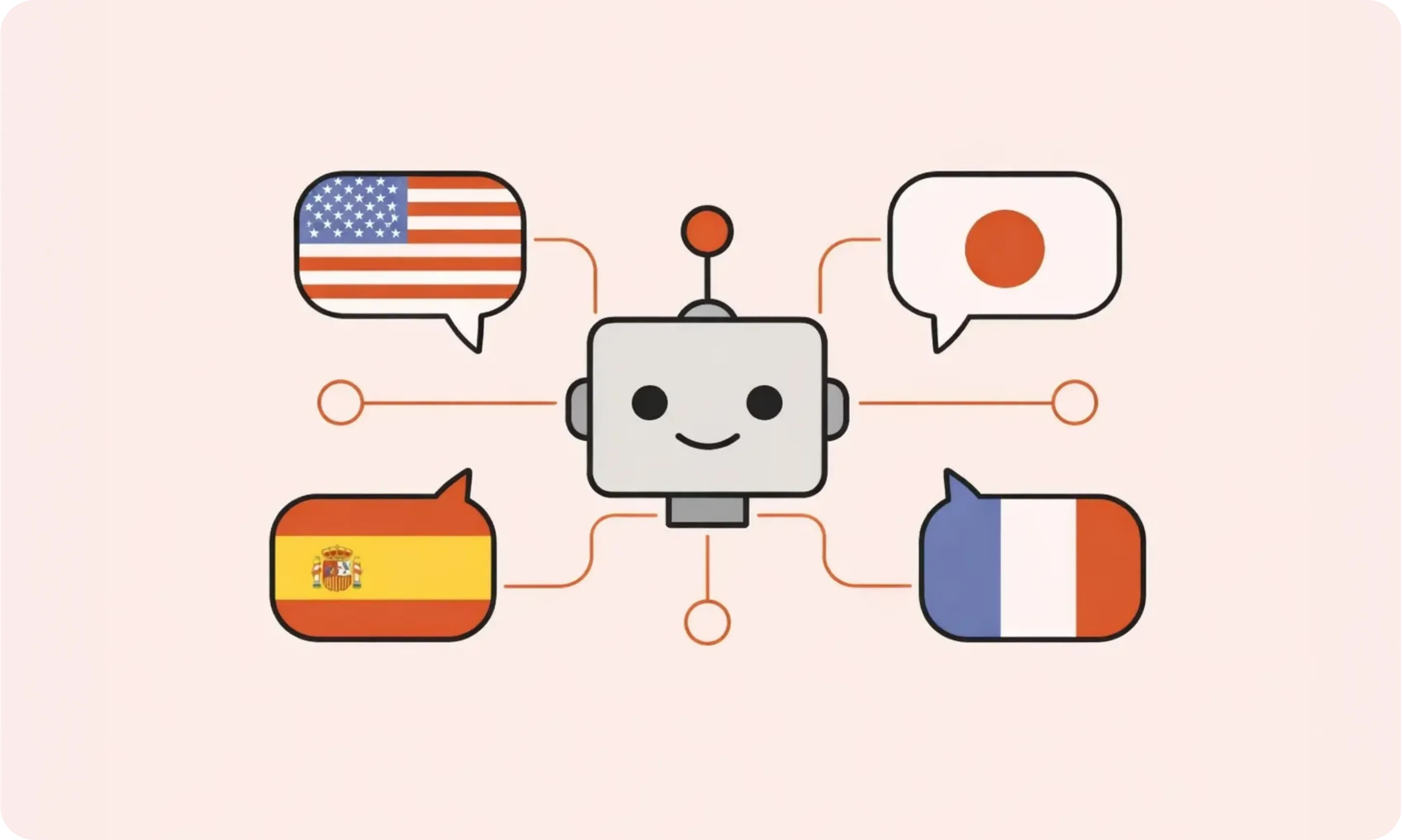
How AI Understands and Speaks Multiple Languages
How AI Understands and Speaks Multiple Languages
If your business operates across borders — or serves customers who speak different languages — you have likely wondered: how well does AI actually handle languages other than English?
The answer, in 2026, is remarkably well. But not equally well for all languages, and not without important nuances that businesses need to understand.
The Multilingual Challenge
Language is one of the hardest problems in AI. Every language has its own grammar, idioms, cultural context, and exceptions to every rule. Multiply that by the world's 7,000+ languages, and the scale of the challenge becomes clear.
For decades, AI systems were built primarily for English. Other languages were an afterthought — lower quality, fewer features, more errors. This created a real barrier for businesses operating in non-English markets or serving multilingual customer bases.
That barrier is falling fast.
How Modern AI Handles Multiple Languages
Large Language Models: Built Multilingual
The latest generation of large language models (LLMs) — including GPT-4, Claude, Gemini, and LLaMA — are trained on text from dozens of languages simultaneously. This means they do not "translate" from English — they understand and generate text natively in many languages.
The results vary by language, with performance generally correlating to the amount of training data available:
- High-resource languages (English, Spanish, French, German, Chinese, Japanese): Near-native quality for most tasks
- Medium-resource languages (Dutch, Polish, Czech, Korean, Portuguese): Strong performance, occasional gaps in specialized vocabulary
- Lower-resource languages (Lithuanian, Latvian, Icelandic, Welsh): Good general performance, but may struggle with highly specialized or idiomatic content
The gap between high-resource and lower-resource languages is narrowing with each model generation.
Natural Language Processing: Beyond Translation
Modern NLP capabilities go far beyond translating text from one language to another:
- Sentiment analysis — understanding whether a customer message is positive, negative, or neutral, regardless of the language
- Intent recognition — determining what a user wants to do (make a complaint, ask a question, place an order) in any supported language
- Entity extraction — identifying names, dates, amounts, product references, and other key information from text in multiple languages
- Summarization — condensing long documents into key points while preserving meaning
- Cross-lingual search — finding relevant information even when the query and the document are in different languages
These capabilities enable businesses to build AI systems that serve customers in their preferred language without maintaining separate systems for each one.
Speech Recognition: Hearing Every Language
Automatic speech recognition (ASR) has made dramatic progress in multilingual capabilities. Systems like OpenAI's Whisper, Google's speech-to-text, and similar platforms can:
- Transcribe speech in 50–100+ languages with high accuracy
- Handle accents and regional dialects
- Process noisy audio and phone-quality recordings
- Detect which language is being spoken automatically
- Handle code-switching (when speakers mix languages in the same conversation)
For businesses, this means AI-powered phone systems, meeting transcription, and voice assistants that work across languages — a capability that was prohibitively expensive just a few years ago.
Text-to-Speech: Speaking Naturally
Modern text-to-speech (TTS) systems produce remarkably natural-sounding voices in many languages:
- Natural prosody — proper intonation, rhythm, and emphasis that sound human
- Multiple voices — different voice options for different contexts
- Emotional tone — the ability to convey warmth, urgency, or professionalism
- Pronunciation accuracy — correct handling of names, technical terms, and loanwords
The result is AI voice systems that customers find natural and comfortable to interact with, even in languages where robotic-sounding speech was the norm just recently.
Practical Applications for Global Businesses
Multilingual Customer Support
Deploy a single AI support system that handles inquiries in all the languages your customers speak. The system understands the question in the customer's language, retrieves relevant information from your knowledge base (regardless of what language it is stored in), and responds naturally in the customer's language.
Global Content Operations
AI can help with creating, adapting, and managing content across languages:
- Draft content in one language and adapt it (not just translate it) for other markets
- Maintain consistency in messaging across languages
- Localize product descriptions, support articles, and marketing materials at scale
International Voice Systems
Build IVR systems and voice assistants that automatically detect the caller's language and respond accordingly — no "press 1 for English" menus required.
Cross-Border Document Processing
Process contracts, invoices, and correspondence in multiple languages using the same AI system. Extract key information, classify documents, and route them appropriately regardless of language.
Multilingual Analytics
Analyze customer feedback, social media mentions, and support tickets across all markets in a unified system. Understand sentiment and trends without language being a barrier to insight.
Challenges and Honest Limitations
Despite remarkable progress, multilingual AI is not perfect. Businesses should be aware of:
Quality variation across languages. AI performs best in languages with abundant training data. For less common languages, expect occasional awkward phrasing, missed idioms, or cultural mismatches. Always have native speakers review AI output for customer-facing content.
Cultural context. Language is more than words. Humor, formality levels, business etiquette, and cultural references vary enormously. AI can handle language mechanics well but may miss cultural subtleties that a human would catch.
Specialized vocabulary. Legal, medical, and highly technical terminology in less common languages may not be well-represented in AI training data. For high-stakes content in specialized domains, human expertise remains essential.
Bias in training data. AI models reflect the data they were trained on. This can lead to stereotypes, cultural blind spots, or uneven quality across demographics within a language.
Regulatory considerations. Processing multilingual data across borders involves GDPR, data residency requirements, and other regulations that vary by jurisdiction.
The Future of Multilingual AI
The trajectory is clear: multilingual AI capabilities are improving rapidly and the gap between major and minor languages is closing. Key developments to watch:
- Better low-resource language support — new training techniques are making it possible to achieve strong performance with less data
- Real-time translation in conversations — AI-mediated conversations where each party speaks their own language
- Culturally-aware AI — models that understand not just language but cultural context and adapt accordingly
- Voice cloning across languages — maintaining a consistent brand voice across all your markets
Making It Work for Your Business
If you serve a multilingual audience or operate internationally, here is how to approach multilingual AI:
- Identify your language priorities — which languages do your customers and operations need?
- Assess quality requirements — customer support may tolerate minor imperfections; legal documents may not
- Build a testing process — have native speakers evaluate AI output in each target language
- Start with your highest-volume language pair — prove the concept, then expand
- Plan for human oversight — AI handles the volume, humans ensure quality and cultural appropriateness
The ability to serve customers in their own language — at scale, around the clock — is no longer a luxury. It is rapidly becoming a competitive necessity.
Want to explore multilingual AI solutions for your business? Contact WiseMonks to discuss how we can help you communicate across languages effectively.